How to optimize validation cost without sacrificing fidelity in PHIL systems
Power Systems
04 / 02 / 2026

Key Takeaways
- PHIL budgets fall when hardware tests are reserved for unresolved, hardware-coupled risk after software verification is complete.
- Fidelity should follow the sensitivity of the failure mode, with closed-loop stability setting the practical ceiling on model detail.
- Cost per kW and labour both improve when model partitioning and test automation remove unnecessary hardware scope and manual effort.
PHIL validation cost drops when you use hardware only for the risks software cannot settle.
Poor software quality cost the U.S. economy at least $2.41 trillion in 2022. That number matters because PHIL is one of the most expensive places to discover issues you could’ve found earlier. Teams overspend when they treat the bench as a universal proof machine. You keep fidelity and cut spend when each PHIL run answers a narrow hardware-coupled question.
Validation in software testing is about proving acceptable system behaviour under the conditions that matter, while verification checks that models, code, and interfaces match their requirements. Power-hardware-in-the-loop belongs at the point where software evidence runs out and hardware interaction begins. That boundary keeps software testing and validation aligned. It also gives you a clean way to optimize simulation budgets without lowering trust in the result.
Validation cost falls when PHIL targets only residual risk
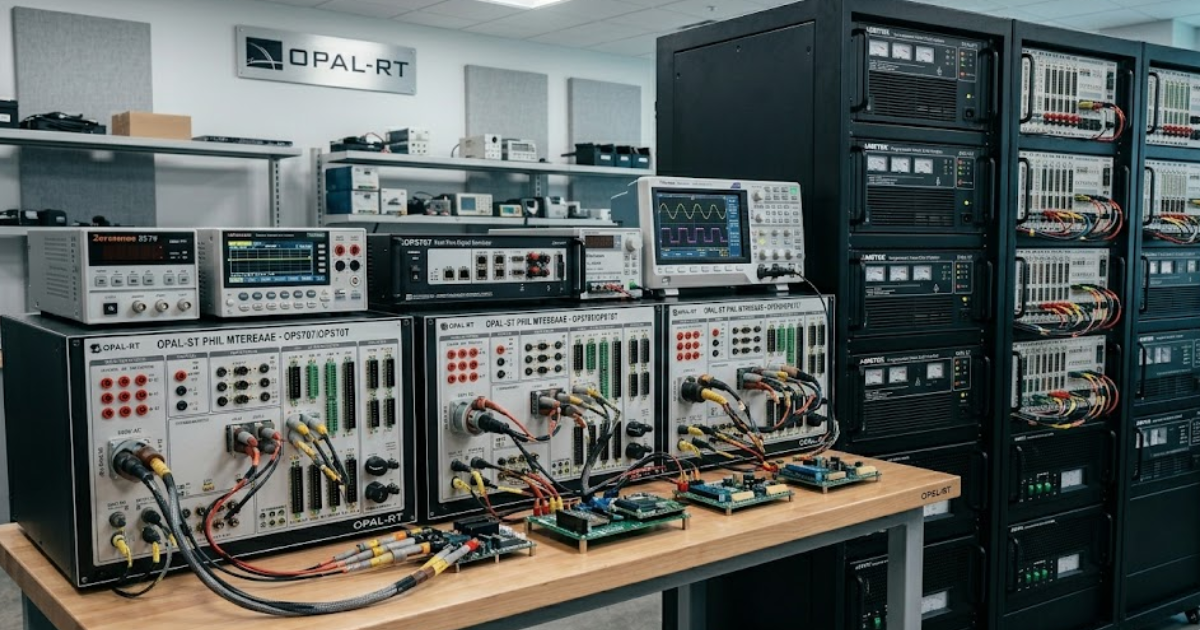
PHIL costs less when you use it to test only the behaviour that still carries uncertainty after software checks. That usually means interface effects, controller timing, saturation, protection trips, and hardware tolerances. Bench time will fall because you’re no longer using power hardware to confirm logic that unit tests already settled. Cost control starts with a narrow risk statement for every run.
A motor drive team gives a clear example. Current-loop logic, fault parsing, and state transitions are verified in model-in-the-loop and software-in-the-loop runs, then the PHIL bench is reserved for dead-time, sensor noise, DC-link sag, and amplifier interaction. That shift cuts repeat runs and shortens setup work. It also sharpens traceability, because every PHIL case maps to a specific residual risk instead of a broad request for more confidence.
“PHIL costs less when you use it to test only the behaviour that still carries uncertainty after software checks.”
Verification versus validation defines what PHIL must prove
Verification and validation in software testing answer different questions, and PHIL belongs on the validation side. Verification checks that models, code, interfaces, and requirements line up. Validation checks that the integrated control system behaves acceptably when hardware dynamics and closed-loop effects are present. PHIL should prove that behaviour rather than re-checking basic correctness.
Teams blur validation versus verification in software testing when a failed PHIL run sends them back to fix a missing requirement or a bad unit conversion. That is verification work, and it should’ve failed earlier at far lower cost. A grid converter project shows the split well. Requirement tracing, controller limits, and message handling belong in software testing and validation layers before any power stage is energised, while a PHIL run should focus on current sharing, ride-through, and protection under electrical stress.
Software testing should retire risk before PHIL execution
Software testing should remove as much uncertainty as possible before PHIL starts. That means unit tests, model checks, interface validation, fault injection, and automated regression on the controller build. PHIL becomes cheaper when its purpose is narrow and explicit. It becomes wasteful when it doubles as a broad debugging stage.
A battery inverter team can script thousands of control permutations overnight, then carry only the few cases with unstable behaviour onto the bench the next morning. That sequence saves money because inadequate software testing infrastructure was estimated to cost the U.S. economy $22.2 billion to $59.5 billion each year. Late failure is expensive in every domain, and PHIL adds power hardware, safety procedures, and lab staff to that bill. You won’t trim validation costs until your validation testing in software testing removes the easy failures first.
Fidelity should match failure sensitivity rather than model ambition
High fidelity only deserves budget when the missing detail can change pass or fail. Model detail should track failure sensitivity instead of personal preference or model pride. If a simplified representation preserves the behaviour under test, it is the better validation choice. More switching detail is not automatically more useful.
Consider an EV charger controller. A detailed switching model makes sense when shoot-through protection, harmonic content, or sub-cycle current limits are under review. A reduced-order plant is enough when you’re checking supervisory sequencing, setpoint ramps, or communication loss. That distinction keeps solver load under control and trims retuning time. You can’t justify a millisecond-sensitive budget with a microsecond model unless the failure mode truly lives at that timescale.
| Budget choice | Use it when | What must remain accurate |
| Detailed switching model | Use this when switching events can trigger the failure you need to prove. | Device timing, dead-time, and commutation behaviour must stay visible. |
| Average-value plant model | Use this when supervisory control is under test and sub-cycle effects do not change verdicts. | Dominant power flow and control-loop response must remain consistent. |
| Full hardware power stage | Use this when physical coupling changes measured behaviour or protection action. | Sensing delay, saturation, and trip logic must stay representative. |
| Emulated peripheral interface | Use this when protocol timing matters more than electrical power exchange. | Packet timing, faults, and recovery paths must remain realistic. |
| Long regression sweep | Use this when parameter spread matters more than peak power handling. | Initial states, resets, and verdict rules must remain repeatable. |
Closed-loop stability sets the upper limit for fidelity
Closed-loop stability is the ceiling on useful fidelity in PHIL. Once latency, amplifier limits, sensor noise, or interface algorithms destabilise the loop, extra model detail stops helping. The lab will spend time tuning around the setup instead of testing the product. Stable coupling comes before richer representation.
A microgrid case makes the point clearly. If the amplifier clips during a voltage sag test, or loop delay distorts the current feedback, the result says more about the bench than the controller. Interface algorithms, damping choices, and sensor filtering need explicit limits before test campaigns start. You’re aiming for a loop that remains predictable, measurable, and repeatable across the cases that matter.
PHIL cost per kW depends on hardware scope
PHIL cost per kW comes from the hardware and protection burden around each tested kilowatt, not from rated power alone. Power amplifiers, sensors, cooling, fixtures, safety systems, and operator time all scale with scope. A small bench with complex conditioning can cost more per kW than a larger, simpler one. That’s why hardware scope matters first.
- Rated power sets amplifier size, feeder design, and thermal margin.
- Voltage range changes insulation, protection, and measurement hardware.
- Fault duty raises breaker, contactor, and safety enclosure cost.
- Bandwidth needs shape amplifier class and interface tuning effort.
- Test duration adds labour, energy use, and reset time between runs.
A 50 kW inverter bench built for fast fault ride-through can cost more per kW than a 500 kW bench used for steady-state dispatch checks. High bandwidth, fault energy handling, and strict protection logic push up the price of each tested kilowatt. That is the clearest way to think about PHIL cost per kW explained in plain language. You save money when rated power matches the narrowest hardware question you still need to answer.
Model partitioning cuts compute spend without weakening evidence
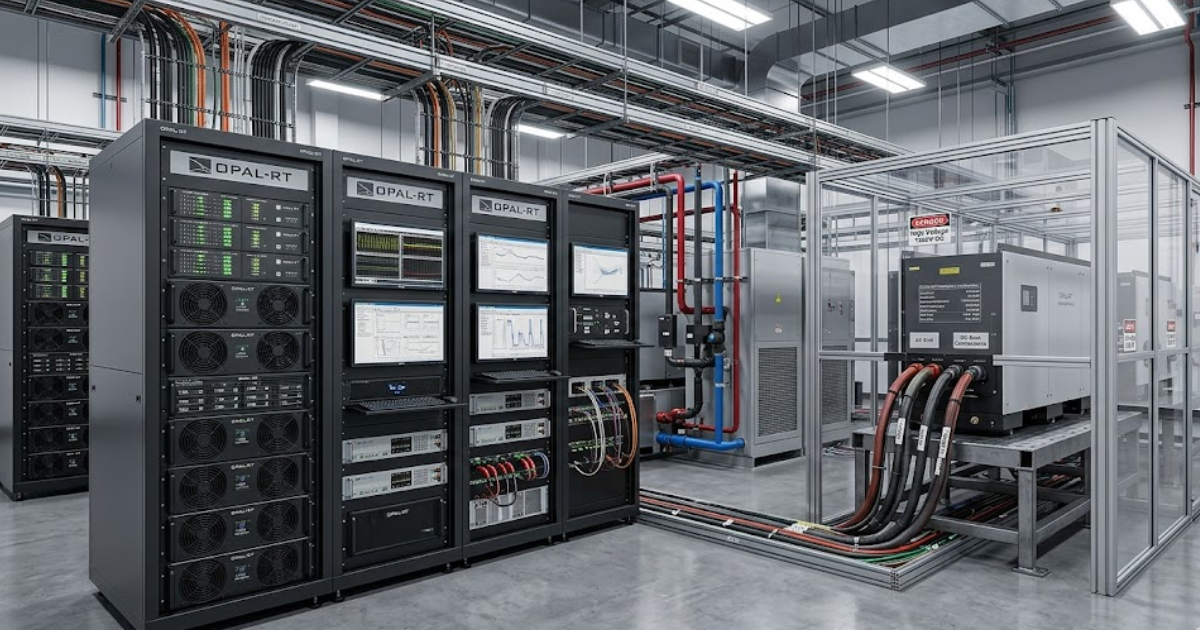
Model partitioning cuts cost when you place only time-critical behaviour on the fastest compute target. Fast switching paths, protection logic, and input/output synchronization stay close to deterministic hardware. Slower thermal, supervisory, or network models can run on less costly resources. Evidence stays intact because each submodel matches its timing need.
A converter lab might keep the plant interface and PWM interaction on FPGA hardware while a feeder model and test sequencer run on CPU cores. That split reduces expensive high-speed capacity without weakening the proof you need from the run. On platforms such as OPAL-RT, teams often use partitioning to reserve the most deterministic resources for the few loops that truly need them. You’ll get a better simulation budget when timing discipline, instead of model size, decides placement.
“More hardware won’t fix a manual process that spends hours preparing each case.”
Test automation lowers validation effort more than added hardware
Automation lowers validation effort because it removes the human work wrapped around every PHIL run. Automated build checks, parameter sweeps, resets, data capture, and verdict logic turn scarce bench time into usable evidence. More hardware won’t fix a manual process that spends hours preparing each case. Repeatability comes from workflow control first.
A lab that scripts startup, injects faults, logs traces, and grades pass criteria after each run will clear more useful cases than a larger bench run by hand. Teams remember the amplifier rating, yet the hidden cost sits in setup drift, operator judgement, and report assembly. That is why disciplined software testing and validation will beat raw hardware spend over time. OPAL-RT fits best in that picture when the platform is treated as part of a controlled test system, with automation and scope doing the heavy lifting instead of bench size.
Real-time solutions across every sector
Explore how OPAL-RT is transforming the world’s most advanced sectors.

Automotive
10 / 21 / 2026
Megawatt charging system validation for heavy duty trucks
A practical look at how the megawatt charging system works, how it differs from CCS and how charger controls are tested before a truck site is energized.
Automotive
10 / 19 / 2026
Dynamometer testing and motor emulation compared for e-drive programs
A comparison of dynamometer testing and motor emulation for e-drive programs, covering what each method proves, what it costs and how teams sequence both.

Power Electronics
10 / 17 / 2026
How wide bandgap devices push converter power density
Wide bandgap devices raise converter power density through faster switching and smaller passives, and this guide traces that chain from device physics to thermal limits to validation.