
Key Takeaways
- Four-quadrant operation matters when your PHIL test includes any interval where the hardware returns energy to the amplifier.
- Sink behaviour and loop bandwidth will tell you more about PHIL accuracy than a large headline power rating.
- The cleanest way to choose an amplifier is to map voltage polarity, current polarity, and power direction across the full test cycle.
4 quadrant operation lets a PHIL amplifier both source and absorb power without losing control of voltage or current.
Electric car sales topped 17 million in 2024, and more than 20% of cars sold were electric, which means more labs are testing converters, drives, and batteries that push energy back into the test interface during normal operation. Most confusion starts when a data sheet says bipolar voltage or bipolar current but says little about returned energy. In PHIL, short for power hardware-in-the-loop, that missing detail decides if the amplifier will stay stable through regenerative braking, fault clearing, or grid support events.
Four-quadrant operation means controlled power flow in both directions

Four-quadrant operation means the amplifier controls positive and negative voltage while also controlling positive and negative current. That gives you all four sign combinations on the voltage-current plane. A four-quadrant amplifier will source power into the device under test and absorb power back from it without losing waveform control.
A battery inverter test shows why that matters. During charge, the amplifier will usually deliver power to the hardware. During discharge, the same hardware sends power back through the interface. If the amplifier only handles one direction cleanly, the PHIL loop stops representing the physical behaviour you meant to study.
Source and sink are not marketing labels. They describe where energy goes during each instant of the test. You can have bipolar voltage output and still lack true sink capability under returned power. That’s why engineers asking what 4-quadrant operation means in amplifiers usually need an energy flow answer first, and a quadrant diagram second.
“A four-quadrant amplifier will source power into the device under test and absorb power back from it without losing waveform control.”
PHIL breaks down when amplifiers cannot absorb returned power
PHIL fails when returned energy has nowhere controlled to go. A sink-capable stage absorbs that energy while holding the commanded signal. A source-only stage will clip, trip, or raise its internal bus voltage until protection steps in. Once that happens, the simulator and hardware stop exchanging the same physics.
A motor controller under deceleration makes this easy to spot. Mechanical energy comes back through the power stage, current reverses, and the amplifier must absorb it at once. If it cannot, the interface voltage distorts during the exact interval you care about most. Fault ride-through tests and grid-forming inverter tests create the same problem.
| Operating condition during a PHIL cycle | What the voltage and current signs mean | What the amplifier must do to stay accurate |
|---|---|---|
| Positive voltage with positive current places the device under test in a motoring or charging state. | Energy leaves the amplifier and enters the hardware under test. | The amplifier must source power while holding the programmed waveform. |
| Positive voltage with negative current shows returned current under positive terminal voltage. | Energy flows back from the hardware into the amplifier. | The amplifier must sink power without lifting its bus or clipping the waveform. |
| Negative voltage with negative current appears when the commanded polarity reverses and current follows it. | Energy again leaves the amplifier, but with opposite polarity. | The amplifier must source controlled power in the reverse direction. |
| Negative voltage with positive current appears when polarity reverses and the device pushes current back. | Energy returns to the amplifier under reverse voltage. | The amplifier must sink controlled power in the reverse direction. |
| A two quadrant stage handles only the sourcing states cleanly during this cycle. | Returned energy in either reverse current condition will upset the interface. | PHIL accuracy drops as soon as the hardware enters a regenerative interval. |
That is why sink behaviour matters more than a simple wattage number. It’s the short handoff that usually breaks the test, not the long steady segment. Power reversal has to stay continuous for the loop to remain credible. Four-quadrant power amplifier performance is judged during that handoff, because that is where PHIL either stays trustworthy or falls apart.
Two-quadrant hardware works only for one-directional exchange
Two-quadrant hardware supports only half of the voltage-current sign map. Some units can reverse voltage but not absorb current, while others can reverse current within a limited voltage range. That still leaves missing operating states, and PHIL will enter those states as soon as the device under test regenerates or commutates.
Confusion starts when bipolar gets treated as a synonym for full four-quadrant capability. A 4 quadrant bipolar amplifier handles both polarities and both power flow directions under control. A bipolar output stage that cannot take returned energy will still fail during a battery discharge pulse or a grid event where current flips before voltage does.
You should read data sheets with one question in mind: what happens when the device under test sends energy back right now? The useful answer will describe continuous sink power, transient sink current, and control behaviour during polarity reversal. If those items are vague, you’re looking at a limited platform even if the terminal voltage swings positive and negative.
Regenerative DUT behaviour is the clearest signal for 4Q need
Regenerative behaviour is the clearest sign that a 4-quadrant amplifier is required. Any device under test that alternates between consuming and returning energy during normal operation will force the amplifier to source and sink. If you expect only one direction of power flow, you can accept a simpler stage. PHIL rarely stays that simple for long.
Utility-scale battery power capacity additions in the United States reached 10.3 GW in 2023, a sharp rise that reflects how common charge and discharge cycling has become in inverter-based systems. Labs now test battery packs, traction inverters, motor drives, charger interfaces, and grid support controls that switch power direction within a single scenario. Each of those setups will expose sink limits immediately. A 4 quadrant amplifier stops that reversal from becoming a lab problem.
- Your test plan includes braking, discharge, or fault recovery intervals.
- Your device under test can raise current against the applied terminal voltage.
- Waveforms cross zero with power flow reversal inside one cycle.
- Protection trips appear only during regenerative intervals.
- Accuracy matters during short transient segments, not only steady operation.
A photovoltaic inverter test gives a plain example. Grid support functions can absorb or inject current depending on the command and the grid condition. A charger test will do the same as control states change. Once you see those operating modes in the test plan, the need for four quadrant operation is settled before you compare rack sizes or price.
Loop bandwidth often matters more than headline power rating
Loop bandwidth often limits PHIL accuracy before power rating does. The amplifier must reproduce the simulator command and absorb returned energy with low delay across the frequencies that matter in your closed loop. A large power stage with slow response will distort fast current reversals, even if its nameplate rating looks generous.
A converter controller with a few kilohertz of crossover frequency will expose this issue quickly. The simulator updates, the amplifier lags, and the measured current arrives late to the controller. Teams working with OPAL-RT see the same rule every day: a fast real-time simulator won’t rescue a power stage that reacts too slowly to source and sink transitions.
You should match bandwidth to the event you need to preserve. Grid faults, current loops, and motor commutation each stress a different part of the response. Rise time alone is not enough. Phase lag, output impedance, and sink stability under reversal are what keep the interface model credible when the waveform stops being gentle.
Poor sink performance creates instability during PHIL transients
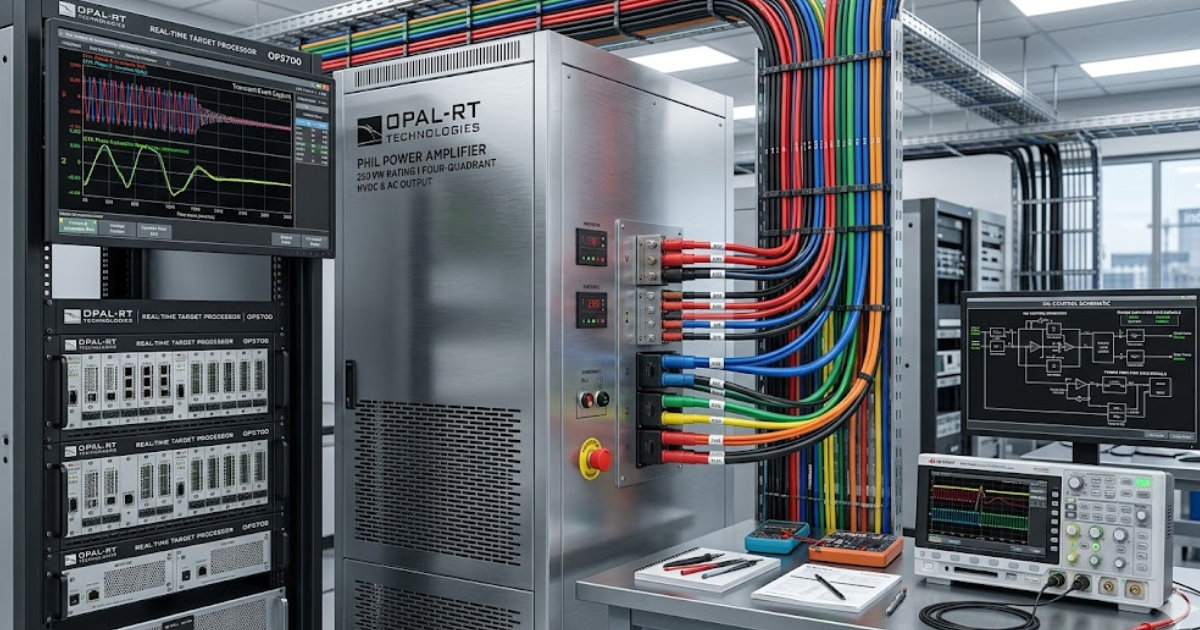
Poor sink performance shows up as instability during the moments you care about most. The amplifier can hit current limits, let the DC bus rise, or flatten the waveform as energy returns from the hardware. Those errors feed back into the simulator and controller, so a local power stage weakness becomes a loop-wide problem.
A fault clearing sequence shows the chain clearly. Current reverses, protective logic responds, and the interface should settle in milliseconds. If the amplifier absorbs that burst poorly, the measured voltage seen by the controller is wrong, so the next control action is wrong too. What looks like controller instability is often sink saturation or delayed recovery in the amplifier.
This is why transient sink specifications deserve close reading. Continuous sink power tells you how long the unit can absorb energy. Short-term overcurrent response tells you what happens during a hard reversal. You’re not just buying directionality here. You are buying stable behaviour when the loop is under stress and the waveform is least forgiving.
“If the cycle asks the amplifier to absorb energy at any critical instant, four-quadrant operation is the disciplined choice and anything less will skew the result.”
Amplifier selection should follow waveform polarity across each test cycle
Amplifier selection should start with a plotted cycle that shows voltage sign, current sign, and power direction at each interval. That single view tells you if two quadrants are enough or if a four-quadrant power amplifier is mandatory. It also keeps you focused on the moments that will break PHIL accuracy first.
A traction inverter cycle makes the method clear. Acceleration sources power, regenerative braking sinks it, and torque reversal can swap polarity before the test settles again. A battery emulator cycle does the same through charge, discharge, and fault recovery steps. When you map those states first, data sheets stop looking abstract and start answering your actual test need.
Good PHIL work comes from matching the amplifier to the energy exchange, not from chasing the largest rack you can afford. That’s why teams using OPAL-RT begin with waveform polarity and returned power before they talk about headline kilowatts. If the cycle asks the amplifier to absorb energy at any critical instant, four-quadrant operation is the disciplined choice and anything less will skew the result.
Real-time solutions across every sector
Explore how OPAL-RT is transforming the world’s most advanced sectors.

Automotive
10 / 21 / 2026
Megawatt charging system validation for heavy duty trucks
A practical look at how the megawatt charging system works, how it differs from CCS and how charger controls are tested before a truck site is energized.

Automotive
10 / 19 / 2026
Dynamometer testing and motor emulation compared for e-drive programs
A comparison of dynamometer testing and motor emulation for e-drive programs, covering what each method proves, what it costs and how teams sequence both.

Power Electronics
10 / 17 / 2026
How wide bandgap devices push converter power density
Wide bandgap devices raise converter power density through faster switching and smaller passives, and this guide traces that chain from device physics to thermal limits to validation.