Why real-time simulation is critical for battery thermal management and safety validation
Simulation, Power Systems
04 / 17 / 2026

Key Takeaways
- Real-time simulation matters most when thermal control, sensing, and safety logic must be proven before full pack hardware is ready.
- Transient loads, closed-loop timing, and repeatable abuse cases reveal failure paths that steady-state models and late bench tests often miss.
- Strong battery safety testing starts with the harshest cooling-limit scenarios and uses physical pack tests to confirm findings, not to find them for the first time.
Real-time simulation cuts battery thermal management risk before pack hardware reaches the abuse lab.
Automotive teams use it because heat problems usually start as control, sensing, and timing problems long before they show up as swelling, smoke, or field returns. Electric car sales reached nearly 14 million in 2023, bringing the global fleet close to 40 million. That scale puts more pressure on every battery thermal management system to prove it can control temperature across charging, propulsion, and fault cases before physical packs are consumed in test.
A desktop model won’t answer the hard validation question. You need the thermal plant, control code, sensors, and fault logic to run at the same pace as the controller so you can see what happens when coolant flow lags, a fan sticks, or a temperature estimate drifts. That is why battery thermal management and battery safety testing move into real-time closed-loop workflows early in serious development programs.
“Closed-loop testing finds faults that isolated software tests miss because the controller has to react to live plant behaviour, I/O timing, and noisy measurements.”
Real-time simulation validates thermal control before pack hardware exists

Real-time simulation lets you validate a battery thermal management system before the first full pack is available. It runs the plant model at controller speed, so software, sensor inputs, and actuator commands interact under the same timing limits they’ll face on the bench and in the vehicle.
A common early case is a fast-charge event after highway driving when cells start warm and coolant enters the loop several degrees above target. A desktop sweep might show stable average pack temperature, yet the real-time setup can expose delayed valve response, pump saturation, or a control map that waits too long to derate charge current.
That matters because thermal control logic is usually approved in stages. If you wait for full hardware, every correction lands later and costs more. Real-time execution gives you a way to prove temperature control, derating thresholds, and recovery behaviour while pack design, software tuning, and safety limits are still flexible.
Transient heat loads expose weak points in cooling strategies
Transient heat loads show where EV battery thermal management actually breaks down. Average temperature rarely causes the first failure. Short bursts of charge or discharge create local peaks that the cooling system cannot remove quickly, and those peaks are what drive uneven ageing, derating, and safety margin loss.
Picture a vehicle that climbs a long grade, stops briefly, then plugs into a high-power charger. Heat from propulsion has not cleared, but the charge profile adds another sharp load. That sequence can reveal a cold plate design that looks fine in steady-state simulation yet leaves edge cells hotter than centre cells during the period that matters most.
Teams that test these sequences early stop treating cooling capacity as a single number. They start asking if the loop can recover fast enough, if flow splits stay balanced, and if controller thresholds react soon enough to prevent local hot spots from stacking into a pack-level issue.
| Validation checkpoint | What the result tells you |
|---|---|
| Repeated acceleration with limited cooldown | The loop has enough thermal margin when heat pulses arrive faster than coolant temperature can recover. |
| Fast charging after a hot soak | The control logic will derate charge power before local cell temperatures drift beyond safe limits. |
| Low flow on one cooling branch | A small hydraulic imbalance can create a large temperature split across modules. |
| Sensor lag during high current events | Filtered measurements can hide a damaging peak even when the average reading still looks acceptable. |
| Cooling restart after a short stop | Recovery speed matters as much as peak cooling capacity for repeatable vehicle use cases. |
| Charge and drive switching under warm conditions | The battery thermal management system must handle thermal history, not just the current operating point. |
Closed-loop testing reveals controller faults bench tests often miss
Closed-loop testing finds faults that isolated software tests miss because the controller has to react to live plant behaviour, I/O timing, and noisy measurements. Problems such as sensor quantization, message delay, estimator drift, and scheduler jitter only become obvious when the control loop is forced to keep up in real time.
A production controller might command more pump speed after a current spike, yet the sensor path can smooth the temperature rise enough to delay the response. On an OPAL-RT hardware-in-the-loop bench, you can connect the actual controller, inject that lag, and watch the pack model overshoot the intended limit even though every individual software check passed.
You’re not just testing code quality here. You’re testing timing discipline across the whole loop. That gives you evidence on calibration choices, fallback logic, and fault thresholds before they harden into release candidates that are painful to retune.
Fault injection shows how thermal runaway precursors spread
Fault injection shows how early warning conditions spread across a pack before a severe event occurs. Real-time models let you place a fault at one sensor, one cell group, or one coolant path and observe how control logic interprets that disturbance across the system in seconds.
One useful case starts with a biased temperature sensor on a module near the outlet of a cooling plate. The controller reads a comfortable value, keeps charge power high, and misses the fact that a neighbouring group is heating faster than expected. Another case uses an internal short proxy at cell level to test if isolation, derating, and alarms trigger in the right order.
These tests matter because thermal runaway precursors don’t arrive with a perfect label. They often look like a small estimation error, a local rise that seems temporary, or a mismatch between current, voltage, and heat generation. Real-time fault injection helps you separate harmless variation from a pattern that needs immediate action.
Battery safety testing needs repeatable abuse cases without pack damage
Battery safety testing needs repeatable abuse cases because destructive pack tests are slow, expensive, and hard to compare one run to the next. Real-time simulation gives you a controlled way to repeat the same thermal and electrical stress path until you understand exactly which variable trips a limit.
Teams usually start with a tight set of abuse cases that expose control weakness quickly:
- Blocked coolant flow on one branch during high discharge
- Temperature sensor bias during fast charging
- Reduced pump speed after a warm soak
- Local cell heat source near a module edge
- Contactor fault during a derating request
Each case isolates a different part of the safety chain. You can compare alarm timing, power reduction, and thermal spread run after run without sacrificing a full pack every time. That repeatability is what turns battery safety testing from a pass or fail event into a validation process you can trust.
Cell to coolant interfaces set the ceiling for model accuracy
Cell-to-coolant interfaces set the ceiling for model accuracy because most thermal errors begin where heat leaves the cell and enters the mechanical path around it. If contact resistance, gap material, clamping force, or channel geometry is wrong in the model, every control result built on that model will carry the same bias.
A pack can look uniform in simulation while one module actually runs warmer due to uneven pressure on a cold plate or a thicker bond line near the edge. Pack designers usually treat a cell-to-cell temperature spread above 5°C as a warning sign because uneven temperatures speed up unequal ageing and imbalance.
You’ll get better validation when the model is calibrated with measured interface behaviour instead of nominal material values alone. That work takes effort, but it keeps you from blaming the controller for a thermal pattern that was actually created by package mechanics and coolant distribution.
Validation should start with scenarios that stress cooling limits
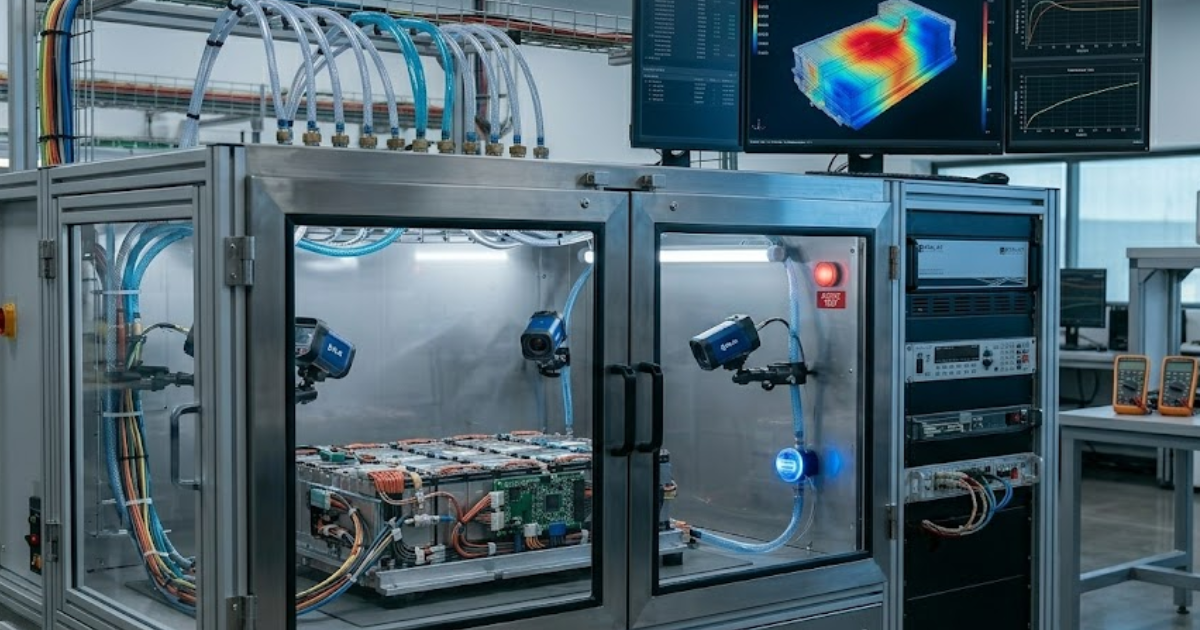
Validation should start with scenarios that stress cooling limits because those cases expose weakness sooner than broad drive-cycle averages. The best first tests combine high current, poor heat rejection, and limited recovery time so you can see if the battery thermal management system protects the pack before margins disappear.
A strong opening sequence is warm cells, high state of charge, fast charging, and reduced coolant performance. Another useful case starts after repeated launches with only a short stop before charging resumes. Cold-weather charging also belongs early because low temperature can push the controller into a tight tradeoff between charge acceptance and lithium plating risk.
Your goal is to rank scenarios by how much they stress thermal limits, not by how easy they are to model. That sequence gives engineers clear evidence on where calibration time should go first, which sensors need better coverage, and which faults deserve pack-level physical confirmation later.
“Better battery thermal management systems come from tighter execution, clearer fault coverage, and validation that keeps pace with the controller from the start.”
Shorter iteration loops cut rework in thermal management programs
Shorter iteration loops cut rework because battery thermal management problems are easiest to fix when the model, controller, and safety logic are still moving together. Teams that wait for late pack tests often get a result without getting understanding, and that slows every correction that follows.
A disciplined program uses real-time simulation to settle thermal limits, controller responses, and abuse-case coverage before expensive physical campaigns begin. That does not replace pack tests. It makes those tests count for more because the team arrives with sharper hypotheses, cleaner fault cases, and fewer unknowns hiding inside the control stack.
That is why engineers keep returning to platforms such as OPAL-RT when they need closed-loop evidence instead of another round of offline assumptions. Better battery thermal management systems come from tighter execution, clearer fault coverage, and validation that keeps pace with the controller from the start.
Real-time solutions across every sector
Explore how OPAL-RT is transforming the world’s most advanced sectors.

Power Electronics
09 / 30 / 2026
FPGA simulation for power electronics and motor drives
A technical comparison of CPU and FPGA solver architectures for power electronics and motor drive simulation, covering the timestep each reaches and how to split a model between them.
Power Electronics
09 / 29 / 2026
How to model and control a T-type three level inverter
An engineering overview of the T-type three level inverter leg, covering how it reaches three voltage levels, where device stress lands, and how neutral point balancing and modulation shape control.
Simulation
09 / 28 / 2026
How CHIL signal-level testing validates embedded controllers
A practical look at signal level controller hardware in the loop testing, covering I/O ranges, sensor emulation, latency and the setup checks that make embedded controller results trustworthy.