Dynamometer testing and motor emulation compared for e-drive programs
Automotive
10 / 19 / 2026
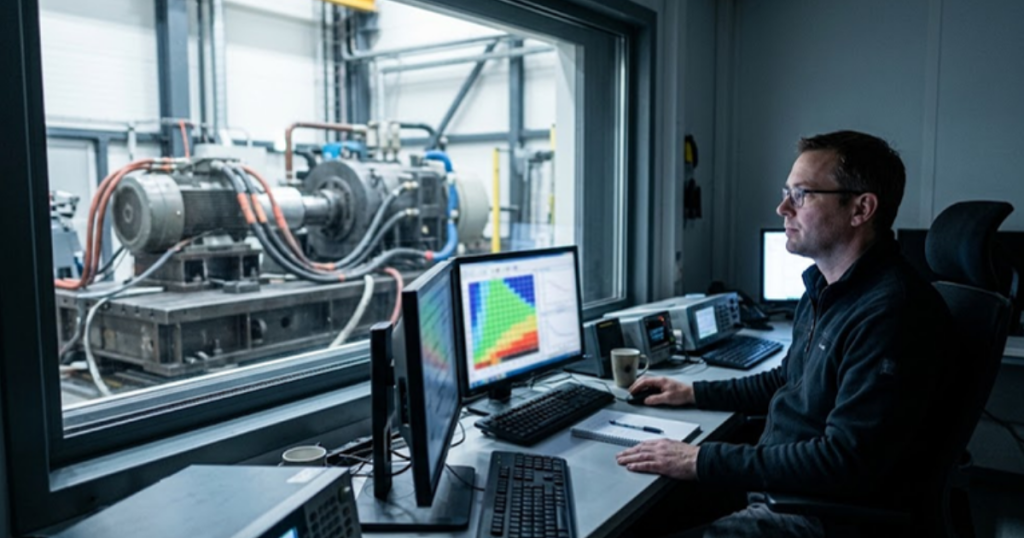
Key Takeaways
- Dynamometer testing validates the complete drive unit on physical hardware, while motor emulation validates the inverter and controls across many machines and faults.
- Emulation fits early, when the design is still open, and the dyno fits late, when efficiency, thermal limits and durability need proof.
- A written handover with shared correlation points keeps dyno hours for evidence that only spinning hardware can give.
Dynamometer testing and motor emulation answer different questions, and your e-drive program will finish sooner when each one is booked for the question it answers best.
A motor dynamometer proves one inverter against one physical machine at a time, with real torque on a real shaft. Motor emulation replaces that machine with a power stage that behaves like it electrically, so the same inverter faces many machines, operating points and faults without a hardware swap. Emulation belongs early and wide, and the dyno belongs late and deep.
The pressure to get this sequencing right keeps growing. Electric models were set to account for more than 1 in 4 cars sold globally in 2025, and every one of those vehicles carries a drive that had to be validated across speed, torque, temperature and fault cases. Programs that reach the dyno cell with untested control software pay for it in idle shifts. Programs that arrive with a proven inverter spend that time on what only spinning hardware shows.
What a motor dynamometer proves that a model cannot
A motor dynamometer proves the complete electromechanical system. It couples the machine under test to a load machine through a shaft and a torque transducer, then measures torque, speed, electrical power and temperature while the drive runs. You get efficiency, heat rise, noise and vibration from the hardware that will ship.
Consider an efficiency map for a traction machine. The cell holds each speed and torque point until temperatures settle, then logs shaft power against electrical input from a power analyzer. Bearing friction, magnet temperature drift, winding hot spots and coolant flow all show up in the result because they’re physically present.
That directness is what you’re paying for. It also sets the limit, since a dyno result describes one machine build, one rotor and one cooling loop. Alter the winding or the magnet grade and the evidence has to be earned again on new hardware.
What motor emulation tests that a dyno cell rarely reaches
Motor emulation tests the inverter and its control software against a machine that exists as a model. A power stage connects to the inverter’s phase terminals and draws the currents a real machine would draw, at full voltage and current, while a real-time simulator computes the machine’s behaviour. No rotor turns, so nothing mechanical limits what you try.
Take a phase short circuit or a position sensor fault at top speed. On a dyno, that test risks a prototype machine, a coupling and sometimes the cell itself, so teams run it once or skip it. An emulated machine takes the same fault dozens of times in an afternoon, with a parameter adjusted between runs.
The same freedom applies to machine variety. Switching from a permanent magnet machine to an induction machine is a model swap instead of a rebuild. You can sweep inductance tolerances and partly demagnetized rotors that no single prototype could represent.
What you give up is everything mechanical. Emulation says nothing about bearings, rotor stress, acoustic noise or how heat leaves the housing.
“No rotor turns, so nothing mechanical limits what you try.”
The main difference between dynamometer testing and motor emulation
The main difference between dynamometer testing and motor emulation is what stands on the other side of the inverter. Dynamometer testing uses a physical machine and a mechanical load, so it validates the whole drive unit. Motor emulation uses a power stage running a machine model, so it validates the inverter and its controls across far more conditions.
A program that needs torque accuracy on a calibration it has already frozen will pick the cell. One still tuning current loops across 3 candidate machines will pick the emulator.
| Question to ask | Dynamometer testing | Motor emulation |
| What faces the inverter during the test | A physical machine coupled to a load machine through a shaft | A power stage that reproduces the machine’s electrical behaviour from a model |
| What the result validates | The complete drive unit, including mechanical and thermal behaviour | The inverter hardware and control software at full power |
| What a machine swap involves | New hardware plus fixtures, shaft alignment and recommissioning | Loading a different model and parameter set |
| How far fault testing goes | Severe faults are limited because they put prototypes and the cell at risk | Severe faults are repeatable because no rotating hardware can be damaged |
| What evidence stays out of reach | Behaviour of machines that have not been built yet | Bearing wear, noise, vibration and true heat rejection |
| Where it fits in the schedule | Late, once the design and calibration are close to frozen | Early, while the inverter and control strategy are still open |
How much electric motor dynamometer testing costs per program
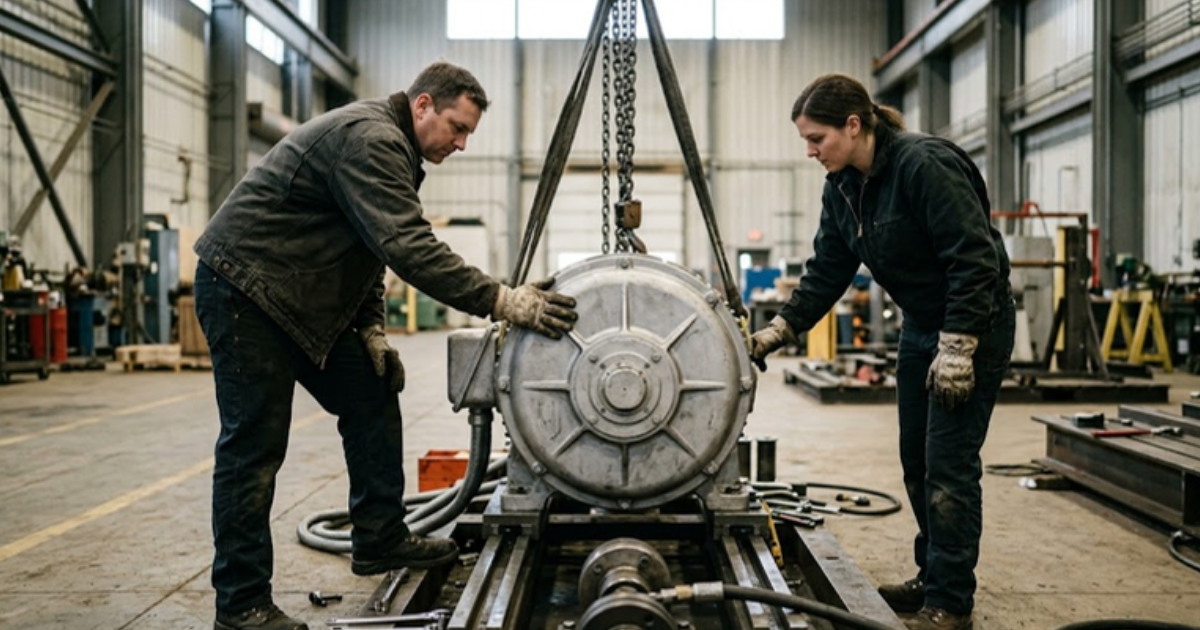
Electric motor dynamometer testing has no single price, because the bill follows cell time, prototype hardware and changeovers more than the tests themselves. Outside labs quote by the shift or the day, and a dedicated cell of your own is a capital project with its own facility work.
A simple illustration shows where the money goes. Suppose a program has 3 machine variants and each changeover takes 2 days for fixturing, shaft alignment and recommissioning. That’s 6 days of booked cell time before a single new data point exists. Add a control bug that stops testing for 1 day per variant, and 9 days have gone to work that produced no evidence. These figures are illustrative.
Budgets leave little room for that waste. United States traction drive cost targets fall from $4.00/kW in 2025 to $3.00/kW by 2030, and validation budgets come under the same pressure. Motor emulation carries its own capital cost, yet its running cost per test is low because nothing wears and nothing needs remounting.
“The saving comes from arriving at the dyno with fewer unknowns.”
When a motor emulator is the better first step
A motor emulator is the better first step whenever the inverter is ready before the machine, or when the test matrix is wider than one prototype can cover. It lets you load the power stage, close the current loops and exercise protections at full power while mechanical parts are still on order.
Five situations point clearly toward emulation first.
- The machine prototype is late or exists in only 1 or 2 units.
- Several machine types or winding variants share one inverter platform.
- Fault responses must be tested repeatedly at high speed and full current.
- Control software is still being tuned and regressions need automated reruns.
- Required operating points sit beyond the speed or power of the available dyno.
Machine model fidelity decides how much those results are worth. A constant-parameter model will hide magnetic saturation and spatial harmonics, so current ripple and torque ripple look cleaner than they will on hardware. OPAL-RT motor emulation benches pair the power stage with machine models from the FPGA Electric Machine Library, so the inverter faces a virtual machine with more detail than a fixed set of inductances.
Ask of any emulation result which machine data fed the model. Finite element data or measured flux maps give you an answer you can defend at a design review.
Can motor emulation replace dynamometer testing for sign-off
Motor emulation can’t replace dynamometer testing for final sign-off, because durability, thermal and mechanical evidence only comes from hardware that turns. It does replace a large share of the dyno hours spent on inverter and control work, which is the work that least needs a spinning shaft. Sign-off still rests on measured efficiency, torque accuracy and endurance.
Durability shows why. No machine model proves that a bearing, a winding insulation system or a rotor will survive years of thermal cycling, so endurance runs, thermal soak and noise measurements stay in the cell. Those hours now start with an inverter whose protections and control loops have already been exercised, so a week of endurance isn’t interrupted by a software fault.
Running both methods in sequence across an e-drive program
The programs that finish cleanly run emulation first and the dyno second, with a deliberate handover between them. Emulation closes out inverter hardware, control tuning and fault response. The dyno then confirms efficiency, thermal limits and durability on the real drive unit, with hours that aren’t spent debugging.
That handover works when you write it down. Decide which test cases exit on the emulator, which repeat on the dyno as correlation points, and what gap between the two you’ll accept. A handful of operating points run on both benches tells you how far to trust the model.
We see the discipline pay off in small ways that add up. Engineers who test inverters against virtual machines on an OPAL-RT bench before they book dyno time walk into the cell with a shorter list. Each one earns its cost when it’s asked the question it was built to answer, and good programs are honest about which question they’re asking this week.

Power Electronics
10 / 17 / 2026
How wide bandgap devices push converter power density
Wide bandgap devices raise converter power density through faster switching and smaller passives, and this guide traces that chain from device physics to thermal limits to validation.
Power Electronics
10 / 15 / 2026
Flying capacitor converter simulation for multilevel designs
How a flying capacitor converter balances its capacitor voltages through switching, where that balance breaks, and what a switching-accurate simulation has to capture.

Industry applications
10 / 12 / 2026
Validating eVTOL electric propulsion before the first flight article
A walk through motor, inverter and battery validation for eVTOL aircraft and the points where real-time simulation carries propulsion evidence ahead of flight test.