8 Factors to consider when choosing real-time simulators for large-scale battery validation labs
Simulation, Power Systems
04 / 15 / 2026

Key Takeaways
- Timing stability, model fidelity, and fault coverage carry more weight than headline compute specifications.
- Large lab performance depends on clean chamber integration, enough I/O, and aligned data across every system involved in a safety run.
- Capacity planning should start with the hardest abuse sequence your team must repeat on schedule, then add headroom for the next validation phase.
Choose a simulator that fits your safety test scope.
Large battery labs need timing accuracy, fault coverage, and enough I/O to keep battery safety testing credible at scale. A weak fit will blur shutdown timing, limit battery cell safety testing depth, and create gaps between chamber results and control behaviour. You’re not buying general compute power. You’re selecting a test instrument that has to stay trustworthy when the pack, chamber, and control stack all interact.
8 factors that shape simulator selection for battery validation labs
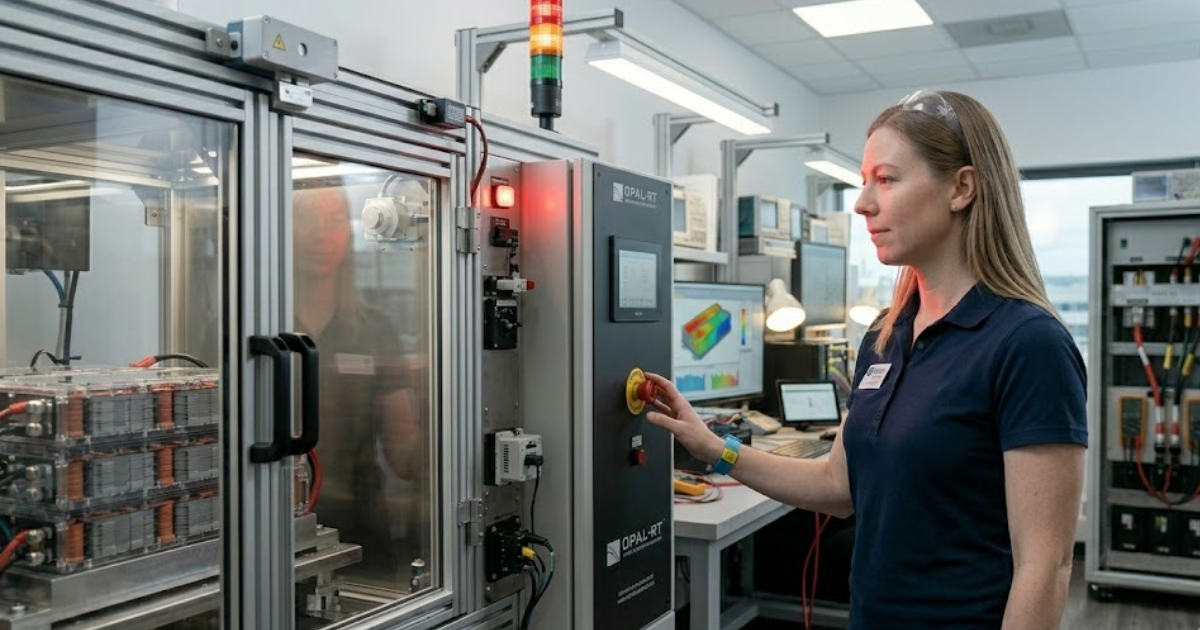
Good simulator selection starts with test credibility, not raw specifications. The right platform will keep timing fixed, model cell behaviour with enough physical detail, inject the faults you actually test, and connect cleanly to chamber controls and lab data systems. Those checks will tell you far more than a processor count ever will.
| Focus area | What matters most |
|---|---|
| 1. Deterministic latency keeps protection timing tests credible | Fixed timing keeps trip and shutdown results trustworthy. |
| 2. Cell-level electrothermal fidelity sets safety test value | Cell behaviour must stay believable under abuse conditions. |
| 3. Fault injection coverage should mirror your abuse test matrix | Test faults should match the failures you plan to study. |
| 4. Channel density must match pack scale throughput | Enough I/O keeps large benches productive and consistent. |
| 5. Safe interfaces fit battery test safety chamber controls | Clean chamber links protect staff, hardware, and test validity. |
| 6. Open toolchains reduce integration friction across lab assets | Compatible tools cut rework across cyclers, PLCs, and scripts. |
| 7. Time-aligned data capture supports traceable safety evidence | Aligned records make root cause work faster and clearer. |
| 8. Compute headroom should match planned lab expansion | Spare capacity prevents early limits as test scope grows. |
1. Deterministic latency keeps protection timing tests credible
Protection timing tests only matter when the simulator responds on a fixed schedule. Small timing drift can hide a slow fuse trigger, a late contactor open, or a delayed shutdown request from the battery management system. A credible platform keeps the same response under heavier model load and across repeated runs. Picture a pack short circuit test where isolation must open inside a narrow time window. If solver timing slips when more analogue I/O and relay logic are added, your battery safety test result stops matching the hardware sequence you meant to validate. You can’t trust a pass result if the test instrument changed the timing chain that the protection logic was supposed to face.
“Protection timing tests only matter when the simulator responds on a fixed schedule.”
2. Cell-level electrothermal fidelity sets safety test value
Battery safety testing loses meaning when the model smooths out the very cell behaviour you need to study. A simulator should represent voltage, current, temperature, and state transitions with enough detail to reflect how cells react during abuse, recovery, and control intervention. Thermal lag matters here just as much as electrical response. A chamber run that heats a module unevenly will expose bad assumptions if the model treats all cells as identical and perfectly coupled. Battery cell safety testing often depends on seeing how one weak cell shifts pack behaviour before a limit is crossed. If the simulator can’t show that spread, the lab will miss failure precursors that decide whether a shutdown rule is useful or merely neat on paper.
3. Fault injection coverage should mirror your abuse test matrix
Fault injection should match the failures your lab is paid to examine. Useful platforms let you trigger electrical, thermal, sensor, and control faults with precise timing so the same scenarios can be repeated during model work, chamber runs, and controller checks. That alignment is what makes comparisons meaningful. A serious abuse matrix might include overcharge, sensor bias, current shunt loss, welded contactors, cooling loss, or a cell internal short. Arc battery safety testing labs also need clean ways to trigger insulation faults and fast protection events without hand-built workarounds each time. When the simulator can’t inject those cases directly, teams start patching tests with external boxes and manual steps, and traceability falls apart.
4. Channel density must match pack scale throughput
Large-scale labs need enough channels to test the pack you actually build, not a simplified version that fits the rack. Channel density covers analogue signals, digital I/O, relay states, temperature points, and communication links, and all of them matter when throughput is the goal. A narrow platform forces compromises long before you see them in a brochure. One bench might need hundreds of cell taps, dozens of thermocouples, chamber signals, and several controller interfaces running at once. If your simulator only supports that load through extra boxes and stitched timing domains, setup time grows and repeatability drops. The better fit is the platform that can hold full pack context in one coherent test loop, with room for a second bench when schedules tighten.
5. Safe interfaces fit battery test safety chamber controls
Interface safety matters as much as model quality when a simulator sits beside high-energy hardware. The platform should connect cleanly to chamber doors, exhaust logic, gas sensing, emergency stop circuits, and isolation devices without forcing unsafe signal conversion or ad hoc wiring. That requirement becomes strict when the chamber is part of the shutdown chain. A battery test safety chamber often sends dry contacts for door status, receives permissive signals, and logs trigger points for venting or suppression systems. If the simulator uses mismatched voltage levels, poor isolation, or awkward terminal layouts, your test setup becomes fragile before the first run. Safe interfaces protect people, preserve hardware, and keep the battery safety test sequence faithful to the chamber controls you rely on.
6. Open toolchains reduce integration friction across lab assets
Open toolchains save time because battery labs rarely test with one software package or one rack of hardware. A useful simulator should accept common modelling workflows, talk to data systems, and exchange signals with cyclers, PLCs, and automation scripts without custom glue for every project. Closed workflows turn routine updates into rework. A lab might build the cell model in one tool, run chamber automation from another, and capture compliance data through a separate historian. OPAL-RT fits this kind of setup when your team needs standard interfaces and model portability instead of a sealed stack. You’re looking for fewer translation steps, fewer manual exports, and fewer moments where a software choice blocks a valid safety run.
7. Time-aligned data capture supports traceable safety evidence
Traceable evidence depends on time alignment across every signal that explains a safety event. The simulator should stamp model outputs, controller actions, chamber states, and trigger markers on one shared timeline so root cause work does not turn into guesswork after a failed run. Good capture is part of the test instrument, not an afterthought. A thermal event review often needs pack current, cell voltages, relay states, gas sensor status, chamber door state, and video marks lined up to the same instant. If those streams drift apart by even a small amount, staff will argue about sequence instead of cause. Clean alignment shortens investigations and gives auditors a coherent record of what the system did and when it did it.
8. Compute headroom should match planned lab expansion
Compute headroom keeps today’s purchase from becoming next year’s bottleneck. Your simulator should run current models comfortably and still leave room for extra cells, richer thermal detail, faster controllers, and additional benches without forcing a complete rebuild of the test setup. Spare capacity protects schedule, not vanity. A lab that starts with module checks often moves to pack level work, coupled charger studies, and hardware-in-the-loop control validation within the same programme. If the platform is already near its limit, every new requirement turns into model trimming or bench reshuffling. Headroom lets you add fidelity where safety questions need it most instead of cutting physics simply to stay inside a compute ceiling.
How to match simulator capacity to lab test scope
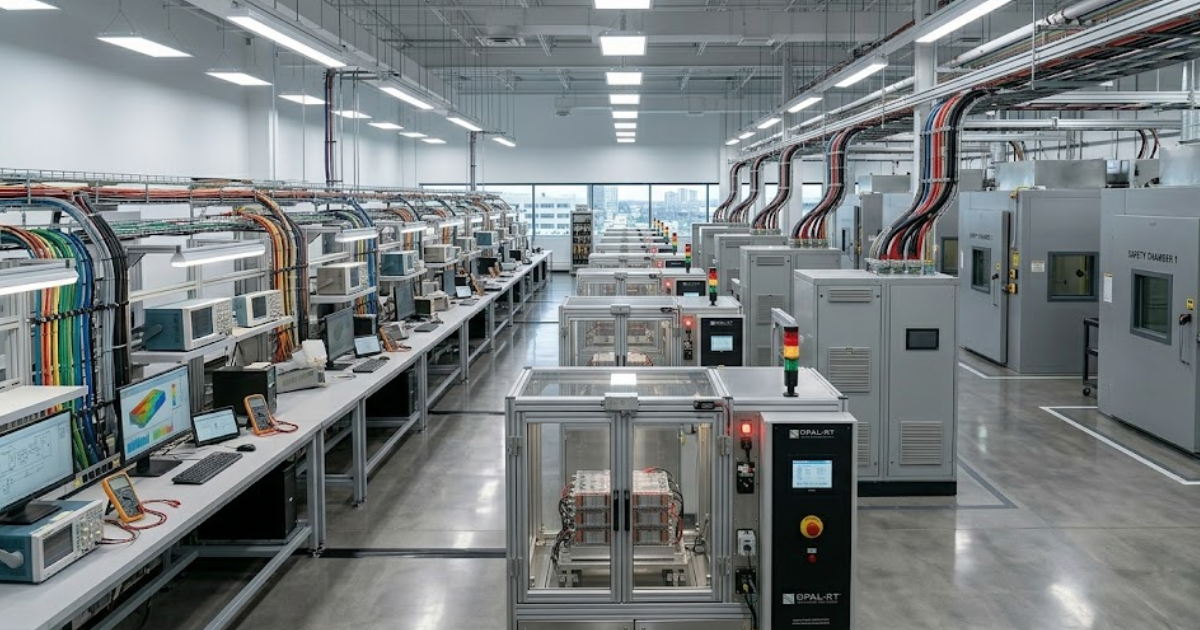
Match capacity to the hardest test you must run on schedule, under chamber control, with traceable data. That means sizing for timing, model fidelity, fault depth, and I/O count as one package rather than treating them as separate purchasing boxes. A smaller platform will look fine until the first full-pack abuse sequence exposes the gaps.
- Map your highest risk safety sequence first
- Count every required signal across the full bench
- Check chamber interlocks before checking processor counts
- Test fault injection against your written abuse matrix
- Reserve compute space for the next validation phase
“Match capacity to the hardest test you must run on schedule, under chamber control, with traceable data.”
Labs that stay disciplined here produce cleaner evidence and spend less time rebuilding test rigs halfway through a programme. That’s why teams often judge platforms in a working bench review instead of a feature sheet review. OPAL-RT enters that conversation when engineers need fixed timing, open integration, and enough scale to keep battery safety testing coherent from cell work through chamber-based pack validation.
Real-time solutions across every sector
Explore how OPAL-RT is transforming the world’s most advanced sectors.
Microgrid
09 / 19 / 2026
Hybrid AC-DC microgrid emulation with power hardware-in-the-loop
An examination of how hybrid AC-DC microgrid stability is set at the interlinking converter and why power hardware in the loop is required to test that boundary at full power.

Power Electronics
09 / 17 / 2026
BLDC motor control fundamentals with simulation examples
A technical primer on six step BLDC commutation, Hall sensor and sensorless back EMF position sensing, torque ripple at each switching instant, and the simulation exercises a teaching lab can run.
Power Systems
09 / 16 / 2026
How to build a protection relay testing workflow utility engineers trust
A practical look at how utility engineers build protection relay testing workflows, from secondary injection through closed loop validation against a real time power system model.