A guide to using real-time simulation for EV fast-charging validation
Power Systems, Automotive
04 / 10 / 2026

Key Takeaways
- Real-time simulation earns its value when it tests the charger controller, electrical model, and communication flow at the same speed as hardware.
- Validation should start with feeder disturbances, battery taper behaviour, and timing faults because those cases shape public reliability more than clean nominal runs.
- Pass criteria need to map directly to session success, recovery time, and stable power delivery so lab results reflect charger uptime.
Real-time simulation is the most reliable way to validate EV fast-charging strategies before public charging starts.
Public fast chargers grew by more than 55% worldwide in 2023, which means every control error now reaches more vehicles and more sites. Real-time simulation lets you test charger control, grid response, battery behaviour, and communication timing in one closed loop before a cabinet goes live. That matters because a failed session starts as a lab miss and ends with a driver searching “EV fast charger near me” and finding a unit that will not start. You need proof that the charger will behave correctly under stress, not just proof that the software compiled.
Real-time simulation validates charging control before field testing begins
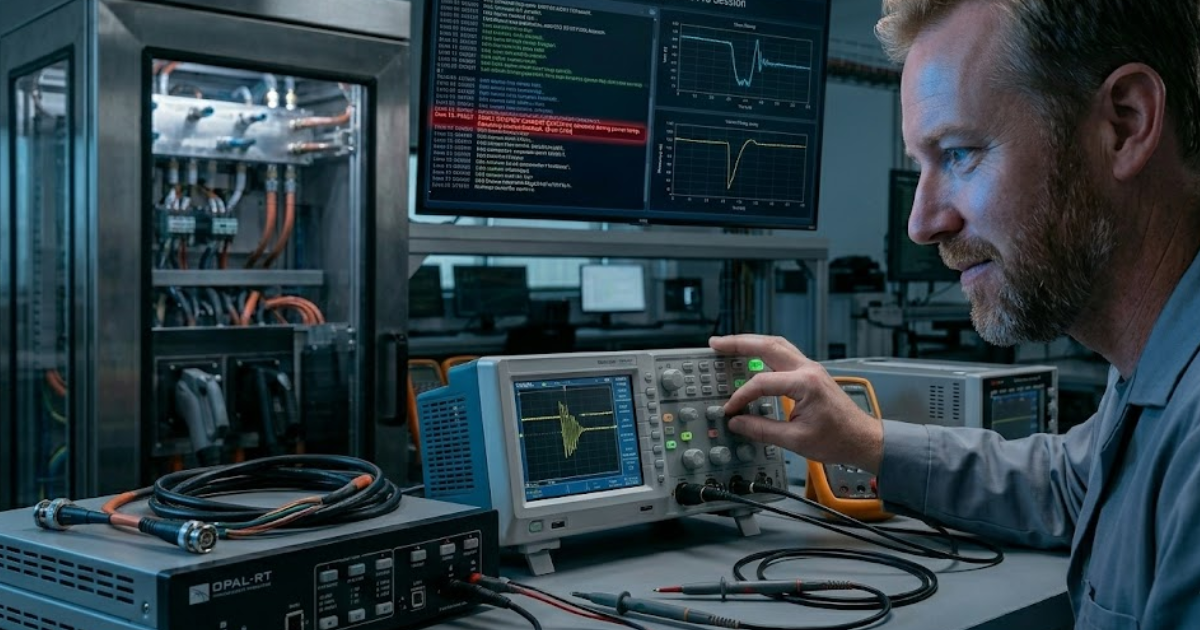
Real-time simulation validates an EV fast charger because it runs the control code against a live electrical model at hardware speed. You see timing errors while they are still easy to fix. You see unstable current loops before site work starts. You also see protection conflicts before a vehicle is connected.
A typical validation case ramps power from idle to full output while the controller reads measured voltage, current, and contactor status through actual input/output channels. If the current reference overshoots during a step from 50 kW to 150 kW, the issue appears in milliseconds instead of hiding inside averaged offline results. That gives you a direct view of charger behaviour under the same timing pressure it will face in public use.
Offline studies still matter, but they will not expose scheduler jitter, communication delay, or sensor noise with the same fidelity. A charger can look stable in a simplified model and still trip when hardware interrupts arrive late. Real-time execution closes that gap. You get evidence that control logic, protection settings, and power stage response will work as one system.
Closed-loop testing reveals charger limits offline models often miss
Closed-loop testing reveals charger limits because the charger controller must react to a model that pushes back in real time. Current commands hit dynamic impedance, thermal derating, and line variation at once. That interaction exposes margins you cannot see in isolated software tests. It also shows how close the charger is to nuisance trips.
A bench setup that includes the power converter model, station controller, cooling logic, and vehicle-side battery model will show where the charger starts to lose composure. A cooling threshold set too high might look harmless until a long session forces output derating at the exact moment the vehicle requests more current. That kind of conflict is common at EV fast charging stations, because sessions are short, aggressive, and sensitive to timing.
| Validation focus | What a passing result actually tells you |
|---|---|
| Power ramp to rated output | The controller reaches target power without unstable current or voltage swings. |
| Cooling limit during a long session | The charger derates smoothly instead of tripping when thermal stress builds. |
| Vehicle current request change | The charger follows the request cleanly and stays within protection limits. |
| Line voltage sag during charging | The control loop reduces stress and keeps the session active when possible. |
| Contactor state transition | The sequence stays coordinated and avoids false fault detection. |
Grid disturbance cases are a first priority in validation
Grid disturbance cases deserve first priority because they stress the charger at the point where power quality, protection, and control all meet. A charger that works only under clean feeder conditions is not ready for deployment. Disturbance testing shows how the unit behaves when voltage, frequency, or phase conditions shift during an active session.
Public direct current fast charging equipment commonly spans 50 kW to 350 kW, so feeder disturbances cannot be treated as edge cases. A site with two 150 kW cabinets can see a sharp feeder sag when another large load connects nearby. Your validation setup should force the charger through that event and confirm that current folds back in a controlled way, insulation checks remain valid, and restart logic stays orderly.
Grid cases matter early because they shape hardware selection, protection settings, and site acceptance criteria. A team that waits until commissioning will end up tuning thresholds under schedule pressure. A team that tests sag, swell, and brief interruption cases in simulation will know which trips are necessary and which ones simply block uptime.
Battery emulation must track pack behaviour across the charge curve
Battery emulation must track pack behaviour across the full charge curve because charger control depends on a moving target. Voltage rises, current limits tighten, and thermal constraints shift through the session. A fixed battery model will hide those effects. That creates false confidence around taper control and session completion.
A useful validation case starts at low state of charge with strong current acceptance, then moves into the taper zone where the vehicle asks for less current as pack voltage climbs. If your emulator holds voltage nearly constant, the charger appears calm and efficient even though the real pack would force a very different response. You will miss overshoot, slow taper tracking, and awkward handoff into session end states.
That detail matters because users judge reliability through session quality, not lab pass rates. A charger that reaches peak power quickly but mishandles taper will feel inconsistent from one vehicle to the next. Good battery emulation lets you tune the control loop around chemistry limits, thermal behaviour, and cable ratings so the charger behaves predictably from plug-in to stop.
Communication timing determines interoperability with vehicles at charging stations
Communication timing determines interoperability because charging depends on a strict exchange of status, limits, and permissions before power rises. A charger can have a sound power stage and still fail sessions if messages arrive late or state transitions are misread. Timing validation proves that the charger speaks clearly under load, faults, and retries.
A common failure appears during the handshake that precedes current delivery. The vehicle signals readiness, the charger checks insulation and contactor state, and a delay of a few hundred milliseconds pushes the sequence outside an allowed window. The result is a failed start that looks random to the driver. Teams running the controller, communication stack, and plant model on OPAL-RT can reproduce that timing chain while electrical transients are still part of the same test.
That approach matters because public charging faults are often blamed on “the station” when the real issue is a small timing mismatch between vehicle and charger. Testing those exchanges with multiple delay patterns and retry paths gives you a stronger basis for interoperability. It also helps explain why two chargers with similar power ratings can show very different behaviour once vehicles begin to queue.
Fault injection shows how recovery logic behaves under stress
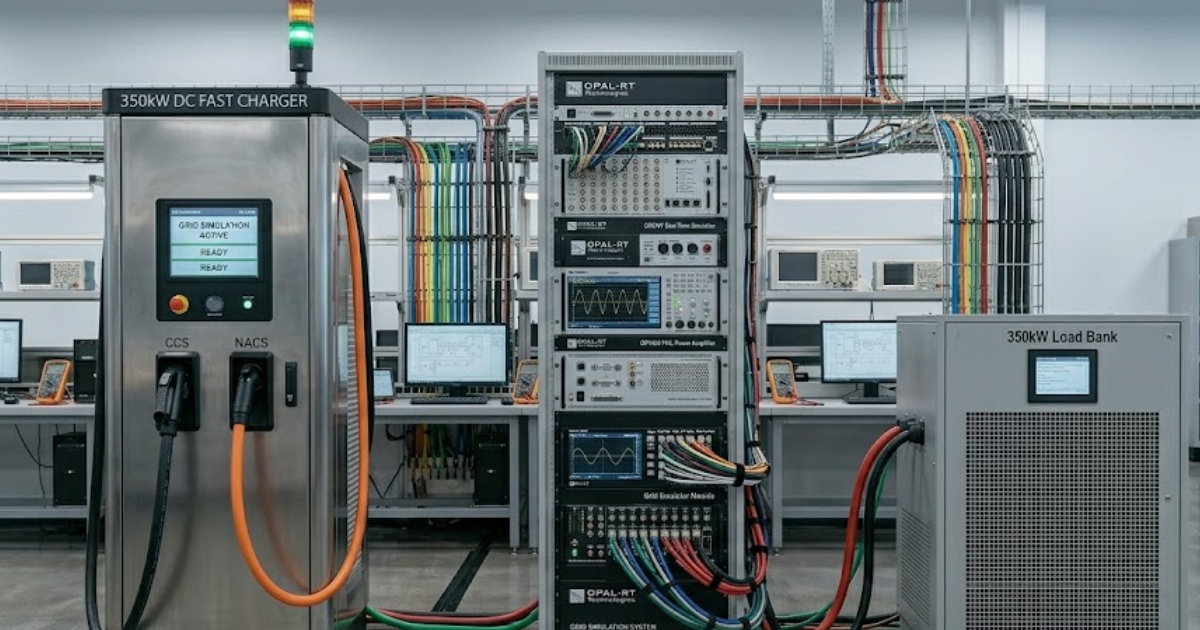
Fault injection shows how recovery logic behaves because the charger must do more than detect trouble. It must shut down safely, preserve useful state, and restart in a controlled sequence. A charger that detects every fault but recovers poorly will still produce failed sessions. Recovery behaviour is part of validation, not a follow-up task.
A solid fault campaign forces the charger through specific events that are easy to miss during routine bench work. The most useful cases are the ones that sit between a clean pass and a catastrophic failure.
- Current sensor bias during a high-power ramp
- Cooling loss during the taper portion of a session
- Communication drop after contactor closure
- Emergency stop during precharge verification
- Welded contactor indication during restart
Each case tests more than protection. You see how alarms are latched, how long restart takes, and whether the charger returns to service without manual intervention. That matters for any site operator, because a driver searching “fast EV charger near me” only sees one result: the station either recovers cleanly or stays unavailable.
Pass criteria should link lab results to charger uptime
Pass criteria should link lab results to charger uptime because lab success only matters when it predicts session success in public use. The right criteria measure stable starts, controlled derating, clean fault recovery, and consistent session completion. Those outcomes connect technical validation to the reliability people actually notice. Anything softer will leave blind spots.
A useful validation plan sets thresholds such as start-up success after a disturbed handshake, current tracking error during taper, maximum recovery time after a forced fault, and acceptable power reduction during feeder sag. Those metrics translate into charger availability far better than a simple pass on individual subsystem tests. They also help you judge one EV fast charger against another on behaviour that affects uptime, queue flow, and user trust.
Disciplined execution is what separates a charger that looks good on paper from one that keeps working at public EV fast charging stations. When a driver types “DC fast charger near me,” the result that matters is the unit that starts, holds power, and comes back after trouble without drama. OPAL-RT fits that job as a lab execution platform because it lets you test timing, electrical stress, and recovery logic in one place before uptime is on the line.
Real-time solutions across every sector
Explore how OPAL-RT is transforming the world’s most advanced sectors.
Automotive
10 / 21 / 2026
Megawatt charging system validation for heavy duty trucks
A practical look at how the megawatt charging system works, how it differs from CCS and how charger controls are tested before a truck site is energized.

Automotive
10 / 19 / 2026
Dynamometer testing and motor emulation compared for e-drive programs
A comparison of dynamometer testing and motor emulation for e-drive programs, covering what each method proves, what it costs and how teams sequence both.

Power Electronics
10 / 17 / 2026
How wide bandgap devices push converter power density
Wide bandgap devices raise converter power density through faster switching and smaller passives, and this guide traces that chain from device physics to thermal limits to validation.