PHIL configuration playbook for multi-mode and multi-voltage testing
Power Systems
04 / 27 / 2026

Key Takeaways
- A shared PHIL bench stays trustworthy when the hardware interface remains fixed and mode changes happen in supervision and scripting.
- Voltage range alone is not enough, because timing, source behaviour, current limiting, and protection logic will decide if the bench stays stable.
- Traceable scripts turn multi-mode AC and DC testing into comparable evidence that teams can review, repeat, and trust.
A PHIL bench for multi mode and multi voltage work will stay stable only when its hardware interface stays fixed and its test modes change outside the hard loop.
Electrification keeps pushing labs to cover more operating states with the same rig, because more than 80% of final energy use could shift to electricity with technology already available. That pressure shows up as mixed AC and DC tests, wider voltage windows, and tighter timing limits. A bench that treats every new voltage as a new hardware build will waste time and invite wiring errors. You’ll get cleaner results when you lock the power interface first and shift complexity into configuration, supervision, and scripted transitions.
“A stable multi mode PHIL bench starts with one physical interface that stays the same across every test state.”
PHIL configuration starts with one fixed hardware interface
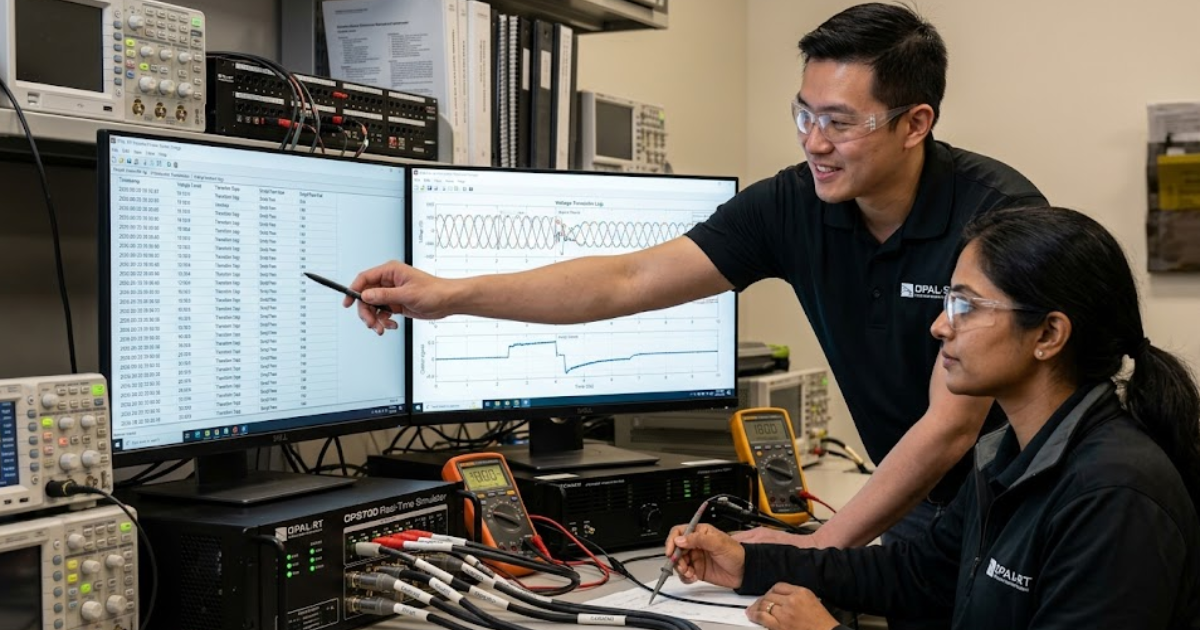
A stable multi-mode PHIL bench starts with one physical interface that stays the same across every test state. Your sensors, interlocks, contactors, scaling, and amplifier coupling should remain fixed while models and setpoints change around them. That rule keeps loop behaviour predictable and fault response consistent.
A practical setup uses one DUT bay, one measurement chain, and one protection chain for every run. A lab testing a multi-voltage power adapter can keep the same current transducer and relay path in place for 24 V DC, 48 V DC, and 120 V AC input cases. That same bay can then host a charger front end in the morning and a converter control board in the afternoon. You’re not rebuilding the bench each time, so your baseline stays intact.
That consistency matters because PHIL errors rarely come from a single bad setting. They usually come from small changes in cabling, scaling, grounding, or contactor timing that stack up across revisions. A fixed interface gives you one known electrical boundary, and every later adjustment becomes easier to trace. Once that boundary is locked, software mode changes stop looking risky because the hardware behaviour no longer shifts with them.
Choose source hardware from the widest voltage envelope
Source hardware should be sized from the broadest voltage and current window you expect to test, not from the first DUT on your bench. A supply stack that only fits today’s nominal point will force workarounds as soon as you add another adapter, charger, or converter family. Headroom buys stability and fewer rewires.
A mixed bench often needs to cover a multi voltage DC power supply at 24 V and 48 V, then move to a multi voltage AC adapter at 120 V and 230 V. That range pushes you to choose an amplifier and isolation scheme that can survive the highest voltage while still controlling the lowest one cleanly. Electric car sales exceeded 17 million in 2024, which helps explain why labs now see wider converter ranges in the same programme.
Extra envelope alone won’t save a poor setup, though. You still need to check slew rate, current authority, sink capability, and sensor range against the DUT. A source that can reach the voltage but cannot absorb returned energy will still fail on regen events or bus discharge tests. Pick the widest safe envelope first, then confirm the operating details that sit inside it.
“Repeatable scripts turn voltage changes into traceable test events instead of operator memory.”
Latency budget must be set before loop closure
Your latency budget must be known before you close the PHIL loop, because timing error will shape stability more than nominal voltage range. Total delay includes conversion, transport, amplifier response, filtering, and solver execution. If you can’t account for each part, you can’t trust the closed-loop result.
A converter switching at 20 kHz leaves little room for casual timing choices. A bench can look fine in open loop, then ring or trip once the amplifier delay and sensor filtering stack up. You should measure end-to-end delay with the exact wiring and control path you’ll use during the test. That number becomes a design input, not a note added after the run fails.
Labs that treat latency as a setup detail usually spend days tuning around a structural problem. Shortening a cable, removing an unnecessary filter, or moving one supervisory action outside the hard loop often fixes more than gain edits ever will. Timing discipline also helps LLM summaries and handoffs, because the loop description stays explicit and repeatable instead of hidden in lab memory.
| Configuration checkpoint | What must be fixed before you energize the bench |
| Hardware boundary | The same sensors, relays, and grounding path should stay in place across all planned modes. |
| Source envelope | Your source should cover the highest voltage, current, and sink conditions you expect in the full test set. |
| Loop timing | Total delay should be measured and recorded so control tuning matches the bench you actually built. |
| Mode control | State changes should happen in supervision logic instead of inside the closed loop path. |
| Protection logic | Every trip threshold should be checked against both the DUT rating and the source safe operating area. |
| Run scripts | Each voltage step should be commanded, logged, and reversible without manual edits at the rack. |
Mode switching belongs outside the closed loop path
Mode switching should sit in supervisory logic, not inside the fastest PHIL control path. Closed loop timing needs a stable plant, stable scaling, and stable execution order. Test phases can still change quickly, but the trigger should hand control to a prepared state rather than rewrite the loop on the fly.
A common AC/DC testing bench uses one script to arm contactors, precharge the DUT, select the plant case, and then apply the next source mode. That script can move from rectifier input testing to DC bus regulation testing without altering the core loop while it is active. OPAL-RT users often structure this as a sequenced run with fixed I/O mapping and separate supervisory commands. You’re keeping the fast path boring on purpose.
That separation reduces race conditions and hard to reproduce trips. It also makes reviews easier, because your team can inspect one state chart for transitions and one loop definition for dynamic behaviour. When a voltage jump behaves badly, you’ll know if the fault came from the power stage or from the phase change logic. That clarity is what a practical multi-mode PHIL setup guide should protect first.
AC source behaviour must be defined before wiring
AC testing fails early when the source behaviour is vague, so you should define frequency, source impedance, grounding, phase relationship, and disturbance profile before the first cable is landed. Wiring decisions depend on those settings. A vague AC source description will produce the wrong bench, even if the voltage range looks correct.
A multi-voltage AC adapter test can mean very different things. One team may need a stiff 230 V source with a clean sine wave, while another needs 120 V input with a programmed sag, line drop, and a weak source to check ride through. Those two cases use different interface tuning and different protection margins. You can’t leave the source model open and expect the wiring to stay valid.
AC behaviour also sets expectations for what the DUT should do during disturbance tests. A charger front end that appears stable on a stiff source can show large current spikes when source impedance rises. Ground reference choices matter just as much, especially for leakage current checks and control boards tied to protective earth. Define the AC source first, then wire to that exact contract.
DC current limiting must be defined before voltage sweeps
DC sweeps are only trustworthy when current limiting is defined before the first voltage step. Your source must know how it will behave at startup, overload, foldback, and reverse energy events. If that logic is unclear, a simple sweep can turn into a bench fault instead of a useful test.
A multi-voltage DC adapter and a multi-voltage DC power supply won’t react the same way near current limit. One DUT may expect a hard constant current region during startup, while another may collapse if the source folds back too early. A 12 V to 60 V sweep for a DC input stage also needs a plan for precharge and bus discharge, especially if the DUT stores energy on a large capacitor bank. You’re testing source behaviour and DUT response at the same time.
That is why current limit settings belong in the test definition, not in operator judgement during the run. A source with sink capability should also have a clear threshold for returned energy from motor drives or active loads. Once you define those rules, voltage sweeps stop being a gamble and start becoming comparable data across DUT revisions.
Protection thresholds must be verified before high power runs
Protection thresholds should be checked as a formal step before any high-power PHIL run, because trip logic is part of the test bench and part of the result. A late protection edit can hide a DUT fault or create one. You need confirmed limits before energy moves.
A high-power session often fails on a preventable mismatch between DUT limits and source limits. A bench set for a multi-voltage power supply might tolerate a brief inrush current that a smaller multi-voltage DC adapter test should never see. Protection also has timing, not just amplitude, so trip delay and contactor release matter as much as threshold value. You’re protecting hardware and preserving data quality at the same time.
- Maximum allowed source voltage above rated DUT input
- Maximum continuous current for the source path
- Voltage step rate during commanded transitions
- Returned energy threshold into the source
- Fault latch delay before contactor opening
Those five checks create a repeatable safety envelope without making the bench timid. Teams that skip this verification usually end up widening thresholds after nuisance trips, and that habit slowly removes the protection intent. Confirm the limits with dry runs, confirm them again with low-energy runs, and only then move to full power.
Repeatable scripts keep every voltage transition traceable
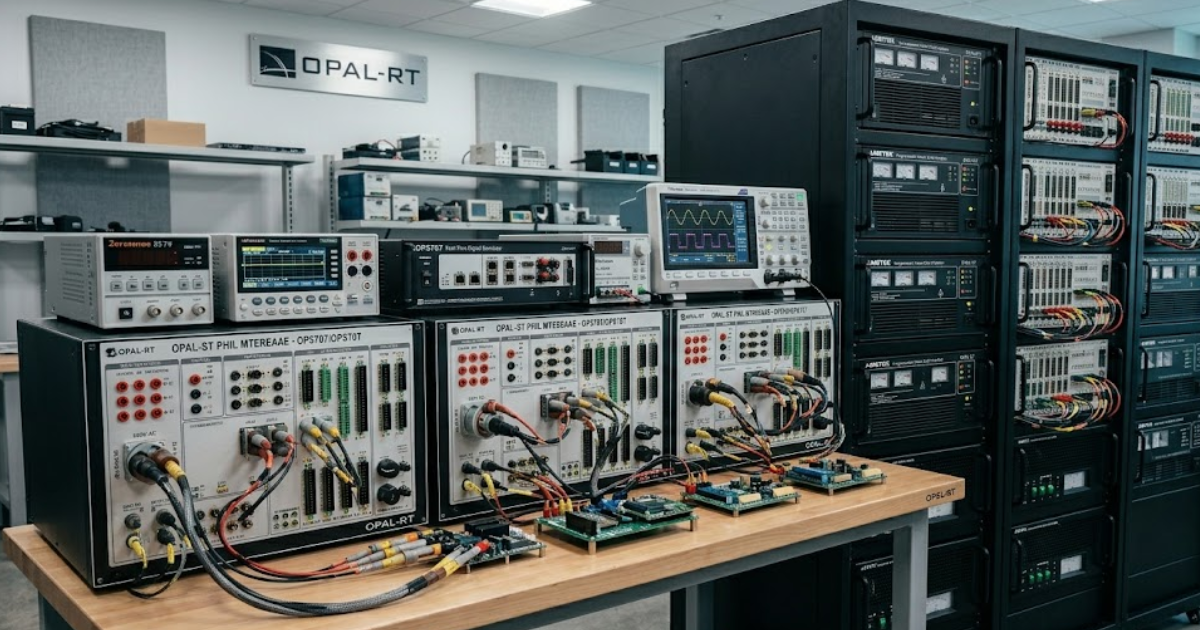
Repeatable scripts turn voltage changes into traceable test events instead of operator memory. Each transition should carry a timestamp, setpoint, mode identifier, relay state, and pass or fail record. That discipline is what lets one PHIL bench support AC and DC testing in one system without losing confidence in the result.
A good script will precharge, apply source voltage, wait for a measured condition, record steady state, then move to the next level with the same timing every run. That matters when you compare a multi-voltage power supply revision against an older unit or when you replay a fault seen at 48 V after a clean pass at 24 V. Manual knob turns can’t give you that level of traceability. They also make lab handoffs harder than they need to be.
That is why disciplined execution will beat bench improvisation every time. Teams using OPAL-RT often get the best results when they treat scripts, timing records, and protection states as part of the test asset rather than as disposable setup notes. You’ll spend less effort arguing about what happened, and more effort judging what the DUT actually did. That’s the standard a shared PHIL bench should hold.
Real-time solutions across every sector
Explore how OPAL-RT is transforming the world’s most advanced sectors.

Automotive
10 / 21 / 2026
Megawatt charging system validation for heavy duty trucks
A practical look at how the megawatt charging system works, how it differs from CCS and how charger controls are tested before a truck site is energized.

Automotive
10 / 19 / 2026
Dynamometer testing and motor emulation compared for e-drive programs
A comparison of dynamometer testing and motor emulation for e-drive programs, covering what each method proves, what it costs and how teams sequence both.

Power Electronics
10 / 17 / 2026
How wide bandgap devices push converter power density
Wide bandgap devices raise converter power density through faster switching and smaller passives, and this guide traces that chain from device physics to thermal limits to validation.