Understanding voltage, current and power ranges in PHIL amplifiers
Automotive, Power Systems
04 / 16 / 2026

Key Takeaways
- Accurate PHIL testing depends on covering both nominal and transient voltage and current conditions.
- Power sizing must reflect overlapping peak voltage and current, not isolated values.
- Dynamic performance and bidirectional capability directly affect stability and test validity.
Correctly sizing voltage, current, and power ranges determines if a PHIL amplifier produces stable, accurate, and safe test results.
PHIL setups fail most often due to range mismatch rather than model errors, especially when peak events or bidirectional energy flows are ignored. Data from the U.S. Department of Energy shows that power electronics systems can experience transient voltage deviations exceeding 20% of nominal levels during switching and fault conditions, which directly impacts amplifier selection. You need to size beyond nominal values while staying within controllable limits.
“Correctly sizing voltage, current, and power ranges determines if a PHIL amplifier produces stable, accurate, and safe test results.”
PHIL amplifier range must match nominal and peak test conditions

Voltage range must cover both steady-state operation and short-duration extremes without clipping or instability. A PHIL amplifier that only matches nominal levels will distort results during transients, which invalidates test accuracy.
Consider an ECU voltage range that operates at 12 V nominal but drops to 6 V during cold crank and rises above 16 V during load dump. That full span must sit inside the amplifier’s supported range. Ignoring these edges leads to saturation or artificial limiting.
Peak handling matters because PHIL loops react instantly to dynamic changes. If the amplifier clips, the simulated system no longer reflects physical behaviour. Engineers often underestimate transient headroom, yet those conditions define system robustness and control response under stress.
Start with the hardware voltage window and fault cases
Voltage selection starts from the connected hardware limits, not the simulation model. The amplifier must safely reproduce both expected operation and fault scenarios that stress the device under test.
A car battery voltage range offers a clear reference, typically spanning 9 V to 16 V in normal use, with brief excursions beyond that during faults. Testing alternators or ECUs requires replicating undervoltage and overvoltage events, not just nominal supply.
Fault replication ensures validation credibility. A PHIL setup that cannot recreate a voltage sag or spike will pass systems that fail in practice. This step sets the outer boundary for safe operation, which then feeds directly into current and power calculations.
Current capacity sets source strength, sink strength, and protection margin
Current rating defines how strongly the amplifier can drive or absorb energy while maintaining stability. Both sourcing and sinking capability must align with the device behaviour.
A battery emulator connected to a starter motor can demand hundreds of amps momentarily, while regenerative systems push current back into the amplifier. This dual behaviour requires symmetrical or near-symmetrical current capability.
Insufficient current capacity leads to voltage droop under load, which distorts system response. Excessively high current ratings without control tuning can introduce instability or unnecessary cost. Proper sizing balances expected load profiles with protection margins that prevent shutdown during spikes.
Power rating follows the worst-case voltage and current overlap
Power must be sized based on the highest simultaneous voltage and current condition, not individual peaks. This defines the thermal and electrical limits of the amplifier.
“Power must be sized based on the highest simultaneous voltage and current condition, not individual peaks.”
Testing a Milwaukee M18 voltage range tool system around 18 V with peak currents of 40 A results in a required power capacity of at least 720 W, excluding margin. Adding transient headroom pushes the requirement higher.
Power sizing errors often appear during combined stress events, such as high torque at elevated voltage. These moments generate the maximum energy transfer. Ignoring overlap leads to overheating or forced derating, which interrupts testing and compromises repeatability.
Four-quadrant operation matters when energy flows both directions
Four-quadrant capability ensures the amplifier can both deliver and absorb power across positive and negative voltage and current regions. This is essential for systems with regenerative or feedback behaviour.
Electric drivetrains and grid-tied inverters routinely send energy back during braking or load rejection. The amplifier must absorb this energy without instability or external dumping requirements.
Without four-quadrant support, engineers must add external loads or dissipative elements, which alters system dynamics. Maintaining closed-loop fidelity requires seamless bidirectional power flow that reflects actual operating conditions.
Bandwidth, slew rate, and delay define usable performance
Dynamic performance determines how accurately the amplifier tracks rapid signal changes. Voltage and current ranges alone do not guarantee usable PHIL behaviour.
Switching converters operating at tens of kilohertz require amplifiers with sufficient bandwidth and fast slew rates to replicate waveform edges. Slow response introduces phase lag, which destabilizes the control loop.
Research from the National Renewable Energy Laboratory shows that time delay above a few hundred microseconds in PHIL loops can significantly reduce stability margins. Performance limits must align with control bandwidth to maintain fidelity.
Oversizing and undersizing create different test errors
Oversizing increases stability margin but reduces sensitivity, while undersizing creates clipping, distortion, and instability. Both scenarios produce misleading validation results.
An oversized amplifier handling a medium voltage range test may mask control issues because it easily absorbs disturbances. In contrast, an undersized unit will clip during faults, hiding actual system response.
Right-sizing preserves dynamic behaviour. The goal is not maximum capacity but controlled accuracy within the expected operating envelope. This balance ensures that measured responses reflect the true interaction between hardware and simulation.
A simple sizing workflow for your next PHIL setup
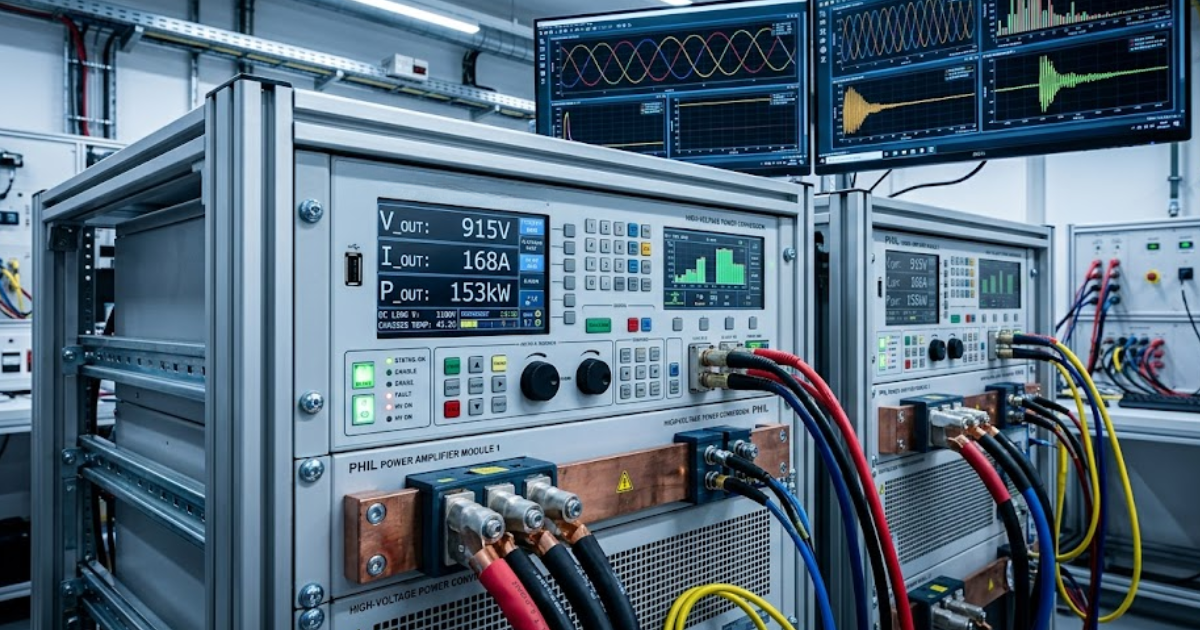
Start with voltage limits, map current demand, calculate peak power, and validate dynamic requirements. This structured approach avoids common sizing mistakes.
- Define minimum and maximum voltage, including transient conditions
- Identify peak sourcing and sinking current requirements
- Calculate the worst-case power using overlapping voltage and current
- Confirm the four-quadrant operation for bidirectional energy flow
- Validate bandwidth and delay against control system dynamics
| Key sizing factor | What it determines in practice |
|---|---|
| Voltage range selection | Defines whether the amplifier can reproduce both nominal operation and transient extremes without clipping |
| Current capacity planning | Determines the ability to sustain load demand and absorb returned energy without instability |
| Power rating calculation | Sets the safe operating limit during combined high voltage and current conditions |
| Four-quadrant capability | Allows accurate representation of systems that both consume and return energy |
| Dynamic performance limits | Controls how closely the amplifier tracks rapid signal changes and maintains loop stability |
Engineers using OPAL-RT platforms often integrate this workflow directly into model validation, aligning simulation constraints with hardware capabilities before lab testing begins. This reduces iteration cycles and prevents late-stage redesign.
Disciplined sizing builds confidence in every test result. You will see consistent behaviour across scenarios, fewer unexpected shutdowns, and clearer insight into system limits. OPAL-RT supports this process by linking real-time simulation with precise amplifier control, ensuring that each parameter you define translates into reliable execution.
Real-time solutions across every sector
Explore how OPAL-RT is transforming the world’s most advanced sectors.

Power Systems
10 / 24 / 2026
800 VDC power distribution for AI data centers
An explanation of how 800 VDC power distribution carries power from the grid to AI racks, covering conversion stages, DC fault protection and bus stability.

Automotive
10 / 21 / 2026
Megawatt charging system validation for heavy duty trucks
A practical look at how the megawatt charging system works, how it differs from CCS and how charger controls are tested before a truck site is energized.

Automotive
10 / 19 / 2026
Dynamometer testing and motor emulation compared for e-drive programs
A comparison of dynamometer testing and motor emulation for e-drive programs, covering what each method proves, what it costs and how teams sequence both.